
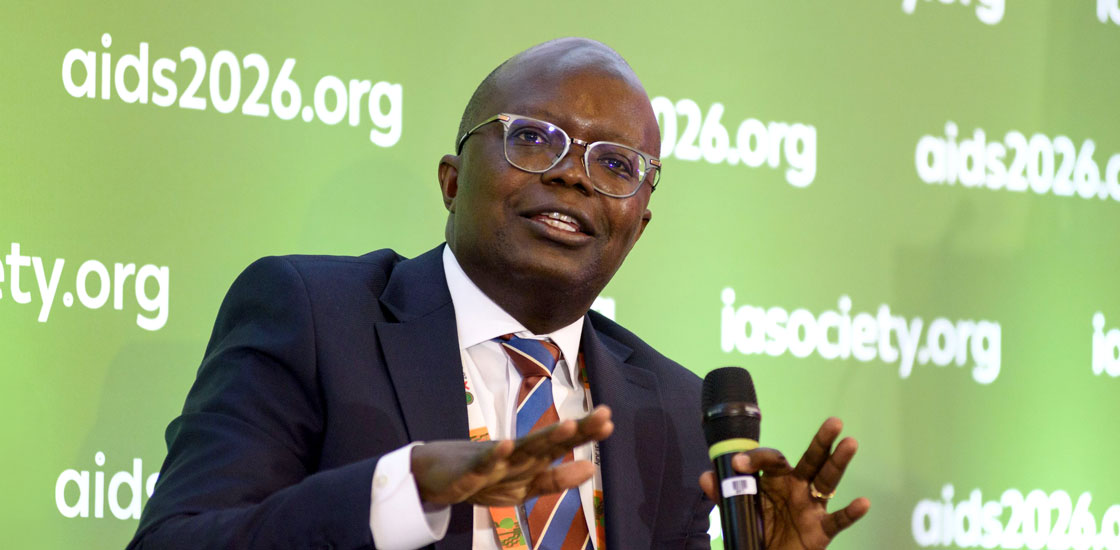
Kenneth Ngure – HIV prevention expert, global health leader, and Associate Professor of Global Health at Kenya’s Jomo Kenyatta University of Agriculture and Technology – shares a message as he begins his tenure as President of the International AIDS Society.
I have been thinking about Ubuntu a great deal as I prepared to serve as President of the International AIDS Society. Ubuntu, a guiding philosophy in many parts of Africa, means: “I am because we are.”
And indeed, I have not arrived at this moment alone. I have been privileged to learn from exceptional mentors, to work alongside outstanding collaborators across Kenya, Africa and around the world, and to serve with colleagues whose commitment to science and public health continues to inspire me.
I also want to acknowledge the communities that have placed their trust in research. Every advance we celebrate today has been made possible because people living with HIV, clinical trial participants, community advisory boards and advocates chose to partner with science. They have taught us courage, resilience and hope.
Defining experiences
Growing up in Kenya, I witnessed firsthand how HIV devastated families and communities. Those experiences shaped my understanding of health, justice and inequality. They also shaped my purpose. Early in my career, I knew I wanted to dedicate my life to helping end this epidemic.
Throughout that journey, the IAS became my professional home. I joined as a member eager to learn and later had the privilege of serving on the IAS Governing Council. Every step reinforced my belief that extraordinary progress is possible when science, communities and leadership come together.
The IAS does far more than convene conferences. It nurtures talent, builds partnerships across continents, transforms ideas into evidence, evidence into policy, and policy into impact. Above all, it reminds us that science has its greatest value when it improves people’s lives.
This moment, for me, is not simply a personal milestone. It is a testament to what the IAS makes possible.
The moment we are in
Today, we stand at a remarkable moment in history. Never before have we had such powerful tools to prevent HIV. Never before has treatment been so effective. Long-acting prevention, advances in treatment, implementation science and digital innovation are redefining what is possible.
Yet, millions of people still cannot benefit from these advances. The greatest challenge before us is no longer simply discovering what works. It is ensuring that what works reaches everyone.
Because science changes lives only when it reaches people.
That simple idea captures the vision I hope we will embrace together – built on three words: Science. Equity. Impact.
Science
Science has always been the foundation of our progress. It transformed HIV into a manageable chronic condition. It gave us antiretroviral therapy, established that undetectable equals untransmittable, and delivered increasingly powerful prevention options, including long-acting technologies that are reshaping the future of HIV prevention.
But discovery is only the beginning. We must continue to invest across the scientific continuum – from basic science to clinical trials, implementation science, behavioural science and health systems research. At a time when misinformation threatens public trust, the IAS must remain an unwavering champion of evidence, integrity and scientific excellence.
Equity
Scientific breakthroughs have little meaning if they remain beyond the reach of those who need them most. The next chapter of the HIV response will be judged by whether every person – regardless of where they live, who they are, or whom they love – can benefit from those innovations.
Equity means ensuring that access to prevention, treatment and care is determined by need, not geography, income, gender or social status. It means protecting human rights. It means confronting stigma and discrimination. It means ensuring that adolescent girls and young women, key populations, children and communities – who are too often left behind – remain at the centre of our efforts.
Communities have always been the heart of the HIV response. People living with HIV, activists, peer educators, community health workers and civil society organizations have transformed science, challenged injustice, shaped policy and held all of us accountable. They are not beneficiaries of the HIV response. They are leaders of it. The IAS will continue to champion meaningful partnerships with communities, because lasting progress is only possible when communities help shape the solutions.
Impact
The true measure of our success is not the number of discoveries we make. It is the number of lives we change.
Impact requires strong health systems, sustainable financing, country leadership and enduring global solidarity. As the global health landscape evolves, countries must increasingly strengthen domestic leadership and investment while the international community continues to stand together in partnership. This includes ending the chokehold of debt on countries that need to invest in their people’s health, and not transfer money to rich countries.
Integration should strengthen – not weaken – the HIV response. By embedding HIV services within resilient primary healthcare systems, while preserving high-quality, person-centred services for the populations most affected, we can build health systems that are stronger, more equitable and more sustainable.
The next generation
There is one commitment that is especially close to my heart: we must invest in the next generation.
When I attended my first IAS Conference in Cape Town in 2009, I benefited from mentors who believed in me, challenged me and opened doors that changed the course of my career. Today, it is our responsibility to do the same.
Somewhere out there is a young scientist who will make the next breakthrough in HIV prevention. A community leader who will transform public health. A future President of the International AIDS Society.
Our responsibility is to ensure they have every opportunity to succeed – through mentorship, support for early-career investigators, opportunities for women scientists and community researchers, stronger leadership from low- and middle-income countries, and the firm conviction that young people should not simply be invited into the conversation, but empowered to lead it.
Science for all
The HIV response has always represented the very best of humanity. It has shown us that science can triumph over fear, that compassion can overcome stigma, that communities can change policy, and that partnership can change history.
Seventeen years ago, when I walked into my first IAS Conference in Cape Town, I wondered where I belonged. Today, I begin this new chapter deeply honoured to serve this remarkable organization.
My hope is that those who follow will inherit a world where science belongs to everyone – where equity is no longer an aspiration but a reality, and where HIV is no longer a threat to public health and individual wellbeing.
History will not remember us simply for the science we discovered. It will remember whether that science reached people.
That is our responsibility. That is our opportunity. And I believe – with all my heart – that together, we can meet this moment.
Together, we can transform discovery into impact.
Together, we can build a more equitable world.
And together ...
We can end AIDS as a threat to public health and the wellbeing of everyone.