
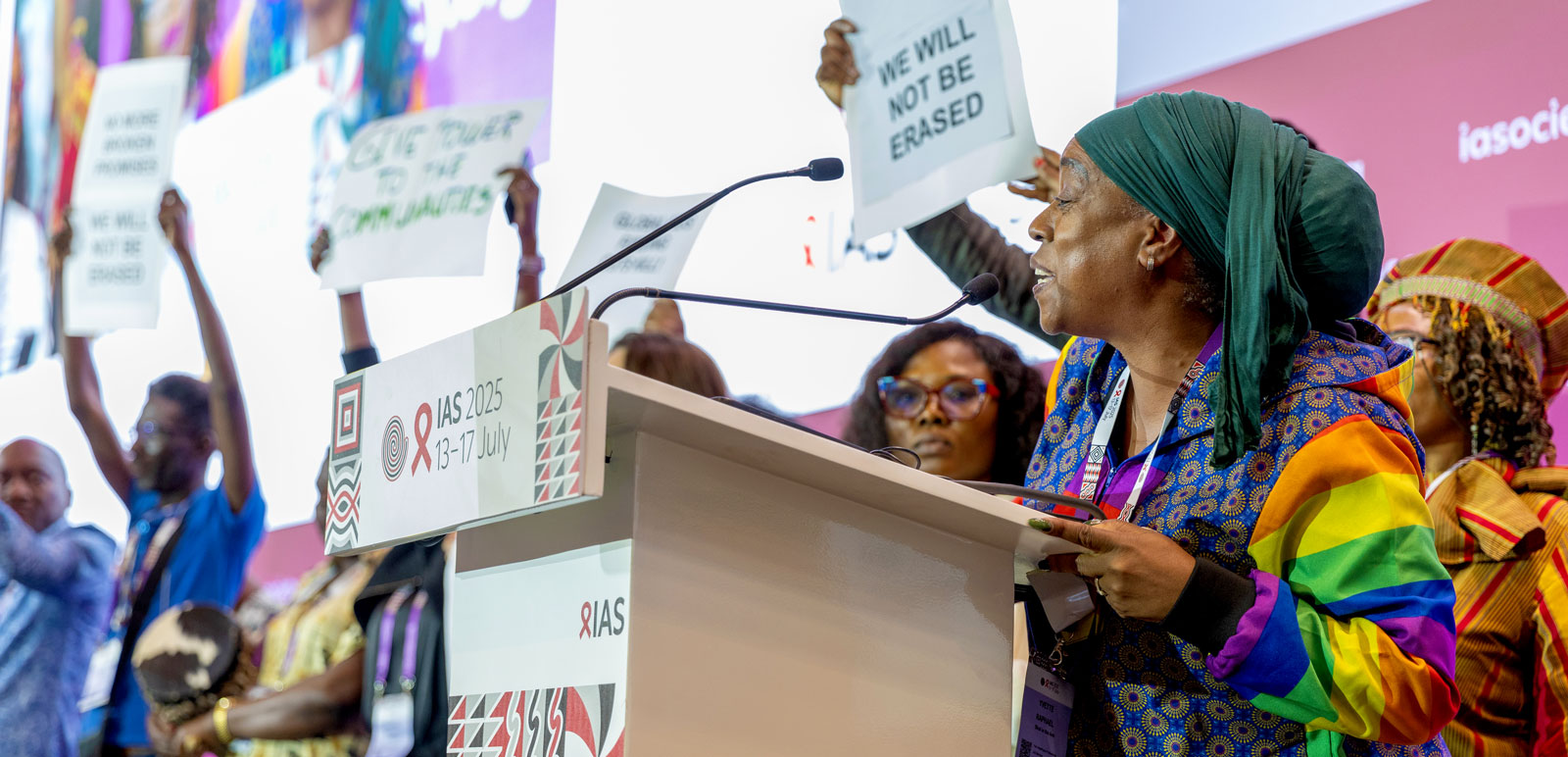
Kigali Declaration
We, the undersigned scientists, academics, advocates, clinicians, programme implementers, elected officials and public health leaders, issue the Kigali Declaration to mark IAS 2025, the 13th IAS Conference on HIV Science, in Kigali, Rwanda.
Over four decades, the global response to HIV has achieved remarkable progress. New acquisitions and AIDS-related deaths have fallen sharply, and millions of people are on life-saving treatment. Today, policy reversals, funding disruptions and attacks on vulnerable communities have put that legacy at risk. Treatment interruptions are increasing and prevention programmes are stalling, leading to more illness and new acquisitions.
Leadership of HIV programmes and research must shift closer to home – to local scientists, health providers and community advocates who understand their communities’ needs. We call on all stakeholders – governments, multilateral organizations, philanthropies and civil society worldwide – to reaffirm HIV as a shared global priority. Achieving this requires a commitment to new partnership approaches, sustained research, scaled prevention, expanded treatment, human rights protections and science-driven policy.
We urge world leaders to recommit to five key principles that will reinvigorate the HIV response:
1. Embrace meaningful partnerships
No country can end the HIV pandemic alone. Progress depends on respectful, mutual partnerships that uphold commitments and deliver results for all populations, especially those most in need. We must preserve international solidarity and scientific collaboration while promoting country ownership and data sovereignty. Strong partnerships, backed by robust investment, enable country-led, community-driven HIV treatment and prevention programmes that are integrated into national health systems and built for long-term sustainability.
2. Support global HIV research
Continued scientific innovation is essential to end the HIV pandemic. Recent advances, including the development of broadly neutralizing antibodies (bNAbs), show promise for a vaccine, essential to achieving a durable end to the pandemic, and we cannot afford to stall. Investment in HIV research has driven breakthroughs that extend beyond the virus – from improved vaccines to cutting-edge treatments and diagnostics benefiting other diseases. We must sustain and expand support for HIV science worldwide, including funding regional centres of excellence and training the next generation of scientists, to ensure that discovery is truly a shared endeavour. Collaborative research with community input and open data sharing will speed the next wave of HIV prevention and treatment tools, vaccine development and, ultimately, a cure.
3. Prioritize HIV prevention
Every person, no matter where they live, should have access to effective prevention options. Yet, prevention coverage today is far below what is needed despite the availability of innovations that are effective in preventing HIV. All countries and partners must urgently accelerate the rollout of proven prevention tools, including condoms, harm reduction services, oral pre-exposure prophylaxis (PrEP) and newer long-acting methods. In doing so, we must harness technology, such as artificial intelligence and other digital solutions, in ethical ways for delivery of accessible, efficient and person-centred HIV and other health services. We must ensure an affordable supply of innovations like long-acting PrEP, supporting community-led outreach to reach those who need it, and integrating HIV prevention into primary healthcare. And all of this must be done while ensuring sustained access to antiretroviral treatment among people living with HIV to protect their health and to mitigate onward transmission.
4. Protect human rights
Public health fails when human rights are denied. To progress towards ending the pandemic, we must ensure equity and inclusion for the most affected communities, including children, LGBTQ+ people, people who use drugs, sex workers, migrants and adolescent girls and young women. Programmes must be designed with and for these communities, tackling stigma and removing punitive laws that drive people away from care. We call on all nations to adopt a human rights-centred approach and remove legal barriers, end discrimination and partner with affected communities in delivering services.
5. Reject the politicization of science
Science – not politics – must guide public health decisions. Leaders must safeguard the independence and integrity of health and research institutions, universities and medical experts so that policies remain grounded in evidence. Experts estimate that the interruption and termination of foreign aid by the US government in early 2025 could cause an additional 60,000 to 74,000 HIV-related deaths in Africa by 2030. Other countries are also cutting HIV funding due to shrinking aid budgets. Every country should enable its public health agencies and scientists to act on data without fear. It is also crucial for governments and multilateral organizations to combat misinformation with information rooted in scientific evidence. This is vital for rebuilding public trust in health guidance. Science, collaboration and compassion have given us the tools to change the trajectory of the HIV pandemic – those same principles must continue to guide us.
It is not too late to course correct. Doing so will require urgent action grounded in science, equity and global solidarity. We must adapt outdated models, unlock new financing and partnerships, embrace innovation and new technologies, and amplify the voices of those most affected.
Let it be that in Kigali in 2025, we seized the opportunity to recommit to global solidarity in the HIV response. On our way to AIDS 2026 in Rio de Janeiro, we must Rethink. Rebuild. Rise.
Sign on now
Notable signers include:
Mumbi Chola, Kigali Call to Action Co-Originator, Centre for Infectious Disease Research in Zambia (CIDRZ)
Jirair Ratevosian, Kigali Call to Action Co-Originator, Duke Global Health Institute
Judith Auerbach, Kigali Call to Action Co-Originator, University California San Francisco
Annie Lennox, Singer, Songwriter and Activist, Founder of The Circle NGO
Françoise Barré-Sinoussi, Nobel Laureate, Institut Pasteur
Kimi Barrow, Former First Lady of Belize, Activist
Tedros Adhanom Ghebreyesus, Director-General, World Health Organization
Jean Kaseya, Director-General, Africa Centres for Disease Control and Prevention
Winnie Byanyima, Executive Director, UNAIDS
Barbara Lee, Mayor of Oakland, California, Former U.S. Congresswoman (D-CA)
Ileana Ros-Lehtinen, Former U.S. Congresswoman (R-FL)
Peter Piot, Former President, International AIDS Society, Former Executive Director, UNAIDS
Sbongile Nkosi & Florence Anam, co-Executive Directors, Global Network of People living with HIV (GNP+)
Zackie Achmat, Founder and Former Chair, Treatment Action Campaign (TAC)
Michel Kazatchkine, Former Executive Director, The Global Fund to Fight AIDS, Tuberculosis and Malaria
Jeanine Condo, CEO, CIIC-HINl, University of Rwanda, Local Co-Chair of IAS 2025
Steve Letsike, Deputy Minister in the Presidency for Women, Youth and Persons with Disabilities, South Africa
Anthony Fauci, Distinguished University Professor, Georgetown University School of Medicine and McCourt School of Public Policy
Anne Aslett, Chief Executive Officer, Elton John AIDS Foundation
John Nkengasong, Former U.S. Global AIDS Coordinator; Global Health Advisor, Mastercard Foundation
Birgit Poniatowski, Executive Director, International AIDS Society
Diane Havlir, Director, AIDS Research Institute, University of California, San Francisco
Rachel Levine, MD, Former U.S. Assistant Secretary for Health
Sharon Lewin, University of Melbourne; Immediate Past President, International AIDS Society
Papa Salif Sow, University of Dakar, Senegal
Rochelle Walensky, Harvard Kennedy School of Government, Former U.S. CDC Director
Tom Frieden, President and CEO, Resolve to Save Lives, Former U.S. CDC Director
Chris Beyrer, Duke Global Health Institute, Former President, International AIDS Society
Glenda Gray, Professor, University of Witwatersrand
Linda-Gail Bekker, Director, Desmond Tutu HIV Center, Former President, International AIDS Society
Beatriz Grinsztejn, President, International AIDS Society
Quarraisha Abdool Karim, CAPRISA, Special Ambassador for Adolescents and HIV, UNAIDS
Matthew Kavanagh, Professor, Georgetown University
Salim S. Abdool Karim, CAPRISA, University of KwaZulu-Natal
Ndidi Okonkwo Nwuneli, President and CEO, One Campaign
Doris Macharia, CEO, Elizabeth Glaser Pediatric AIDS Foundation (EGPAF)
Charles King, CEO, Housing Works
John Heilman, Vice Mayor, City of West Hollywood
Wafaa El-Sadr, Director, ICAP at Columbia University, Professor of Epidemiology and Medicine, Mailman School of Public Health
Laron Nelson, Associate Dean for Global Affairs and Planetary Health, Yale School of Nursing, Research Director, REALITY Program
Magda Robalo Correia e Silva, Institute for Global Health and Development, Former Minister of Health, Guinea-Bissau, Former WHO Director of Communicable Diseases
Prasada Rao J.V.R., Plan India International, Former UN Special Envoy on HIV/AIDS in Asia and the Pacific, Former Director, India’s National AIDS Control Organization (NACO)
Kenneth Ngure, Chair, Department of Community Health, Jomo Kenyatta University of Agriculture and Technology (JKUAT)
Charles Holmes, Director, Center for Innovation in Global Health, Georgetown University
Adeeba Kamarulzaman, Monash University Malaysia, Former President, International AIDS Society
Madhukar Pai, Associate Director, McGill International TB Centre; Canada Research Chair in Translational Epidemiology and Global Health
Solange Baptiste, Executive Director, International Treatment Preparedness Coalition (ITPC)
Mitchell Warren, Executive Director, AVAC
Kevin Frost, CEO, amfAR – The Foundation for AIDS Research
Gregg Gonsalves, Yale School of Public Health
Micheal Ighodaro, Executive Director, Global Black Gay Men Connect (GBGMC)
Saman Zia-Zarifi, Executive Director, Physicians for Human Rights (PHR)
Yvette Raphael, Co-founder, Advocacy for Prevention of HIV and AIDS (APHA)